I am learning flutter from JustAcademy, They provide very much great environment where people gather and work simultaneously. totally project based training institute.
MOHD ABU BAKAR ANSARI
Flutter Developer
Awesome Experience. I am a Front-end Web Designer working at Star India for 3 years now. I applied for Full-stack development and my experience has been phenomenal & they really do help with placements exceptionally. Thank you Roshan sir so much.
Devesh Chaturvedi
Full-Stack Development
27 May, 2026
REST API Testing, Postman Interview Questions and Answers for Freshers and Experienced Testers in 2026
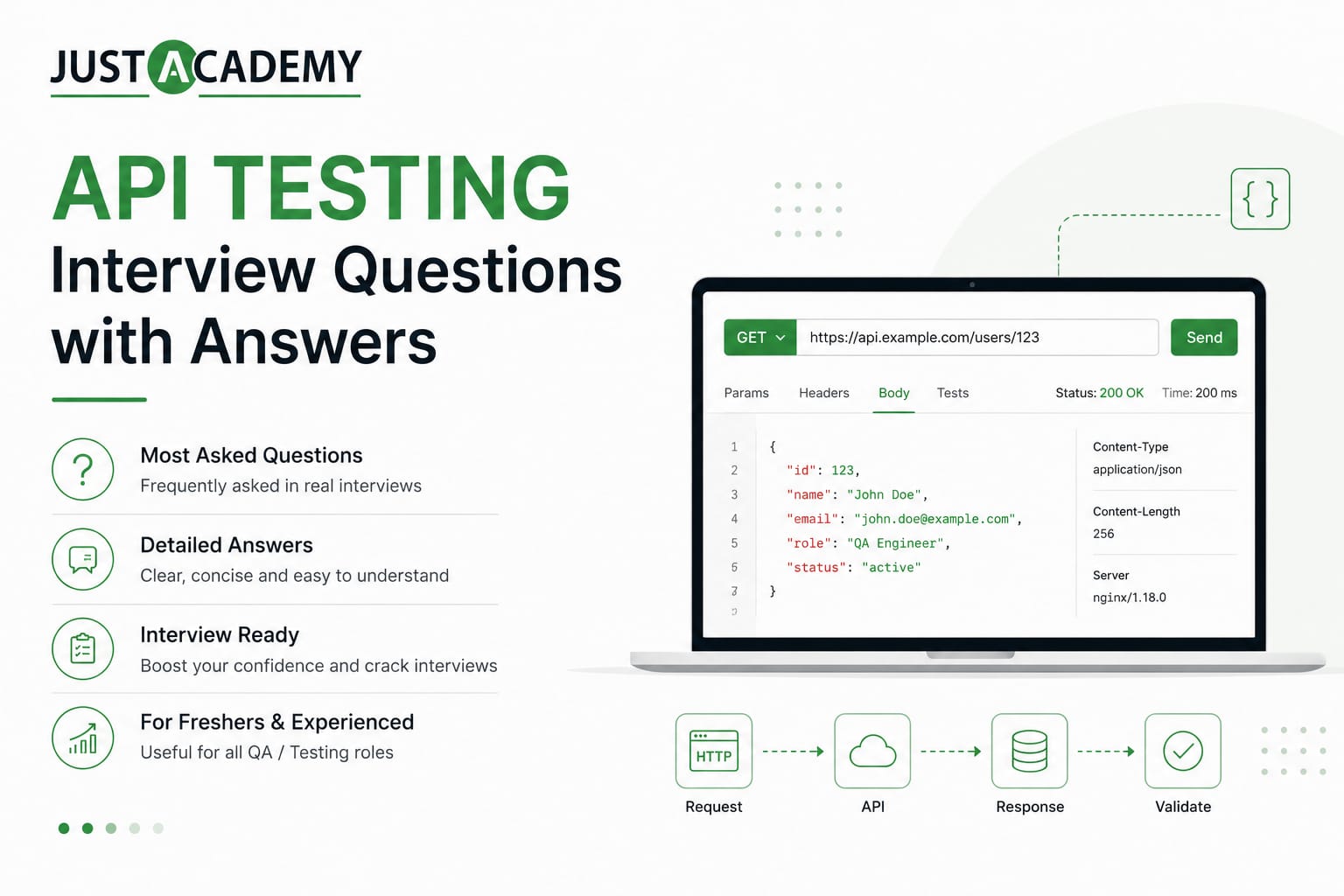
API testing has become one of the most consistently assessed skill areas in QA and software development interviews across India in 2026. Whether you are a fresher appearing for your first QA role or an experienced tester transitioning into automation, being confident with api testing interview questions, REST API testing concepts, and Postman interview questions separates interview-ready candidates from the rest of the pool.
This blog covers the most asked api testing interview questions and answers for freshers and experienced testers, organized from foundational theory to advanced REST API testing, Postman interview questions, authentication, and automation integration. Every question is numbered for easy navigation. Whether you are preparing through the best course in Mumbai with classroom-based offline training or through live interactive sessions available globally online, this guide gives you complete coverage of what interviewers ask in 2026.
API Testing Fundamentals: Interview Questions Every Fresher Must Know
1. What is an API and why is it important in software testing?
An API, which stands for Application Programming Interface, is a defined contract that allows two software systems to communicate with each other by exchanging requests and responses. In the context of software testing, APIs are important because modern applications are built in layers where the frontend user interface communicates with a backend service through API calls. Testing the API layer independently of the UI allows testers to validate business logic, data processing, and system integrations faster and with greater precision than UI testing alone. API testing catches defects earlier in the development lifecycle, is faster to execute, requires less maintenance than UI test suites, and provides more stable results because APIs change less frequently than UI elements.
2. What is the difference between API testing and UI testing?
API testing validates the functionality, reliability, performance, and security of application programming interfaces directly at the service layer without interacting with the graphical user interface. It communicates with the backend using HTTP requests and validates responses based on status codes, response bodies, headers, and response times. UI testing interacts with the application through the browser or mobile interface as an end user would, validating visual elements, navigation flows, and rendered content. API testing is faster, more stable, and easier to maintain than UI testing because it does not depend on page layouts, element locators, or rendering behavior. Best practice in QA automation follows the testing pyramid, which recommends a large base of API tests, a smaller set of UI tests, and unit tests at the foundation.
3. What are the different types of APIs?
APIs are classified by their access model and architecture style. By access model, public APIs are available to any developer and are documented openly. Private APIs are used internally within an organization and are not exposed externally. Partner APIs are shared with specific business partners under controlled agreements. By architecture style, REST APIs use HTTP methods and are the most widely used style in modern web and mobile applications. SOAP APIs use XML-based messaging and are common in enterprise and financial systems. GraphQL APIs allow clients to request exactly the data they need in a single query. gRPC APIs use Protocol Buffers for high-performance service-to-service communication. Most api testing interview questions for freshers focus on REST APIs because they dominate the current job market.
4. What is REST and what are its core principles?
REST, which stands for Representational State Transfer, is an architectural style for designing distributed hypermedia systems. REST APIs follow six core constraints. Client-server separation means the client and server are independent and communicate only through the API interface. Statelessness means each request from the client must contain all the information needed to process it, and the server does not store client session state between requests. Cacheability means responses should indicate whether they are cacheable to improve performance. Uniform interface means the API follows consistent conventions for resource identification, manipulation through representations, self-descriptive messages, and hypermedia navigation. Layered system means the client does not know whether it is communicating directly with the server or through intermediaries. Code on demand is an optional constraint allowing the server to send executable code to the client. RESTful APIs that follow these principles are scalable, maintainable, and easy to consume.
5. What are HTTP methods and how are they used in REST API testing?
HTTP methods define the type of operation being requested from a REST API. GET retrieves a resource or a collection of resources and should not modify any server-side data. POST creates a new resource and the request body contains the data for the resource to be created. PUT updates an existing resource in its entirety by replacing it with the data in the request body. PATCH partially updates an existing resource by applying only the specified changes. DELETE removes a resource identified by the URI. HEAD is similar to GET but returns only the response headers without the body, used for checking resource existence and metadata. OPTIONS returns the HTTP methods that the server supports for a specific resource, used for CORS preflight checks. In Postman interview questions, candidates are frequently asked to explain when to use PUT versus PATCH and the difference between POST and PUT.
6. What are HTTP status codes and which ones are most important for API testing?
HTTP status codes are three-digit numbers included in API responses that indicate the result of the request. Status codes in the 2xx range indicate success. 200 OK is the standard successful response for GET, PUT, and PATCH requests. 201 Created is returned when a POST request successfully creates a new resource. 204 No Content indicates a successful request with no response body, common for DELETE requests. Status codes in the 4xx range indicate client errors. 400 Bad Request indicates the server could not understand the request due to invalid syntax. 401 Unauthorized indicates that authentication is required and has not been provided. 403 Forbidden indicates the client is authenticated but does not have permission. 404 Not Found indicates the requested resource does not exist. 422 Unprocessable Entity indicates the request is well-formed but contains semantic errors. Status codes in the 5xx range indicate server errors. 500 Internal Server Error indicates an unexpected server-side failure. 503 Service Unavailable indicates the server is temporarily unable to handle requests. Verifying that the correct status code is returned for each scenario is the first assertion in any API test case.
7. What is a request and response in API testing?
A request is the message sent from the client to the API server. It consists of the request line containing the HTTP method and endpoint URL, request headers that provide metadata such as Content-Type and Authorization, query parameters appended to the URL for filtering or pagination, path parameters embedded in the URL to identify a specific resource, and a request body containing the data payload for POST, PUT, and PATCH operations. A response is the message returned by the server. It consists of a status code indicating the result, response headers providing metadata about the response, and a response body containing the returned data, error messages, or confirmation. In API testing, testers validate both the structure and content of the response against expected values defined in the test case.
8. What is JSON and why is it the most common format for REST API payloads?
JSON, which stands for JavaScript Object Notation, is a lightweight data interchange format that represents data as key-value pairs, arrays, strings, numbers, booleans, and null values using a syntax derived from JavaScript object literals. It is the most common format for REST API request and response bodies because it is human-readable, compact, language-independent, natively supported by JavaScript and modern programming languages, and easily parsed and generated by virtually all frameworks and libraries. JSON has largely replaced XML as the preferred API payload format for web and mobile APIs because of its simplicity and smaller payload size. Understanding JSON structure, nested objects, arrays within JSON, and data type validation is essential for any API tester.
9. What is XML and when is it still used in API testing?
XML, which stands for Extensible Markup Language, is a structured markup language that represents data using nested tags with attributes. It was the dominant format for web service data exchange before JSON became prevalent. XML is still used in SOAP-based web services, which remain common in banking, insurance, healthcare, and government enterprise systems. XML is also used in some REST APIs where legacy systems require it, in document-centric data exchange, and in industry-specific standards like HL7 in healthcare and FIX in finance. API testers working with enterprise systems or SOAP web services must be able to read XML responses, write XML request bodies, and use XPath expressions to validate specific fields within XML responses.
10. What is the difference between SOAP and REST APIs?
SOAP, which stands for Simple Object Access Protocol, is a protocol with strict standards for message format, transport binding, and error handling. REST is an architectural style with flexible conventions rather than rigid standards. SOAP uses XML exclusively for messages while REST supports JSON, XML, plain text, and other formats. SOAP uses the HTTP POST method for all operations while REST uses the appropriate HTTP method for each operation type. SOAP has built-in standards for security, transactions, and reliability through WS-Security, WS-Transaction, and WS-ReliableMessaging while REST relies on HTTPS for security and handles transactions at the application level. REST APIs are simpler to develop and consume, and are the dominant choice for new web and mobile applications. SOAP is still required in enterprise environments where its built-in standards are needed.
Feature
REST
SOAP
Protocol vs Style
Architectural Style
Protocol
Data Format
JSON, XML, others
XML only
HTTP Methods
GET, POST, PUT, PATCH, DELETE
POST only
Performance
Faster, lighter payloads
Heavier XML overhead
Security
HTTPS, OAuth, API keys
WS-Security standard
Use Case
Web, mobile, microservices
Enterprise, banking, healthcare
REST API Testing Interview Questions for Core Concepts
11. What is an endpoint in REST API testing?
An endpoint is the specific URL at which a REST API resource can be accessed. It is composed of the base URL of the API server, the path that identifies the resource or collection, and optional path parameters. For example, in the endpoint https://api.example.com/v1/users/42, the base URL is https://api.example.com, the version prefix is v1, the resource collection is users, and 42 is the path parameter identifying a specific user. Each endpoint combined with an HTTP method represents a distinct API operation. In API testing, the complete list of endpoints and their supported methods is documented in the API specification, and each combination is a test scenario to be covered.
12. What is a query parameter and how does it differ from a path parameter?
A path parameter is a variable embedded within the URL path that identifies a specific resource. For example, in /users/42/orders/7, both 42 and 7 are path parameters identifying a specific user and a specific order. A query parameter is appended to the URL after a question mark and used for filtering, sorting, pagination, or other optional modifiers. For example, /users?status=active&page=2&limit=20 uses query parameters to filter by status and control pagination. Path parameters are mandatory and identify which resource to operate on. Query parameters are typically optional and modify how the resource collection is returned. In Postman, both are easily configured in the request URL editor and the Params tab respectively.
13. What are request headers and which headers are most commonly tested?
Request headers are key-value pairs sent with an API request to provide metadata about the request. The most commonly tested headers in API testing are Content-Type, which specifies the format of the request body such as application/json, Authorization, which carries authentication credentials such as a Bearer token or Basic Auth credentials, Accept, which tells the server what response format the client can handle, X-Request-ID or X-Correlation-ID for distributed tracing, and API-specific custom headers that carry version information or client identifiers. Testing headers involves verifying that the API returns the expected response when correct headers are provided, that it returns 400 or 415 Unsupported Media Type when Content-Type is incorrect, and that it returns 401 when the Authorization header is missing or invalid.
14. What is authentication and what are the most common authentication mechanisms tested in APIs?
Authentication in APIs is the process of verifying the identity of the client making the request. The most common mechanisms tested in API interviews and in practice are Basic Authentication, which sends a base64-encoded username and password combination in the Authorization header; API Key authentication, which passes a secret key in a header or query parameter; Bearer Token authentication using JWT or opaque tokens, where a token obtained from a login endpoint is included in the Authorization header as Bearer followed by the token value; OAuth 2.0, which is a delegation framework where users grant specific access to applications through an authorization server without sharing credentials; and API Key plus secret combinations used in services like AWS for request signing. Postman supports all of these authentication mechanisms through its Authorization tab.
15. What is the difference between authentication and authorization?
Authentication is the process of verifying who the requester is, establishing identity through credentials like username and password, tokens, or certificates. Authorization is the process of determining what an authenticated identity is allowed to do, enforcing access control rules that define which resources and operations each user or role can access. In API testing, authentication testing involves verifying that unauthenticated requests receive 401 Unauthorized responses and that valid credentials produce successful responses. Authorization testing involves verifying that authenticated users can only access resources and perform actions permitted by their role, that a regular user cannot access admin endpoints, that one user cannot access another user's private data, and that privilege escalation attacks are prevented.
16. What is a REST API response body and what should testers validate in it?
The response body is the data payload returned by the API server in response to a request. For JSON APIs, it is a structured JSON object or array containing the requested data, confirmation of the operation, or error details. Testers should validate the response status code, the response body structure to confirm all expected fields are present, the data types of each field such as string, integer, boolean, or array, specific field values for deterministic operations, the absence of fields that should not be present in a given context such as passwords, the response time for performance validation, response headers for content type and cache control, and error response structure for negative test cases to confirm that error messages and error codes follow the API contract.
17. What is an API contract and what is contract testing?
An API contract is a formal specification that defines the agreed interface between an API provider and its consumers. It specifies the available endpoints, HTTP methods, request parameters, request body schemas, response body schemas, status codes, and authentication requirements. Common contract formats include OpenAPI Specification documented in YAML or JSON, also known as Swagger, and RAML. Contract testing verifies that the provider API continues to fulfill its contract and that consumers are building integrations against the accurate specification. Consumer-driven contract testing tools like Pact allow consumer teams to define their contract expectations independently and verify them against the provider without requiring a full integrated environment.
18. What is idempotency in REST APIs and why does it matter for testing?
An HTTP method is idempotent if making the same request multiple times produces the same result as making it once. GET, PUT, DELETE, and HEAD are idempotent methods. POST is not idempotent because calling it multiple times creates multiple resources. PATCH may or may not be idempotent depending on implementation. Idempotency matters for testing because testers should verify that repeating a PUT or DELETE request does not produce unintended side effects, that the response is consistent across repeated calls, and that the system handles concurrent duplicate requests correctly. A common test scenario is verifying that sending the same DELETE request twice returns 200 or 204 on the first call and 404 on the second, confirming the resource was deleted and does not exist for the second request.
19. What is the difference between positive and negative testing in API testing?
Positive testing validates that the API behaves correctly when called with valid, expected inputs. It verifies that a successful GET returns the expected data, that a POST with valid data creates the resource and returns 201, that a PUT with valid data updates the resource correctly, and that a DELETE successfully removes the resource. Negative testing validates that the API handles invalid inputs, edge cases, and error conditions gracefully. It verifies that missing required fields return 400 Bad Request, that invalid data types return appropriate errors, that requests without authentication return 401, that requests with insufficient permissions return 403, that requests for non-existent resources return 404, and that malformed JSON in the request body is handled without a 500 error. Both positive and negative test coverage are expected in a professional API test suite.
20. What is boundary value testing in API testing?
Boundary value testing verifies API behavior at the extreme edges of acceptable input ranges. For a field that accepts integers between 1 and 100, boundary tests would send the value 1 as the minimum valid boundary, 100 as the maximum valid boundary, 0 as one below the minimum, and 101 as one above the maximum. For string fields with length constraints, boundary tests would send strings at exactly the minimum length, exactly the maximum length, one character shorter than the minimum, and one character longer than the maximum. Boundary values are where most data validation bugs occur because developers often implement range checks with off-by-one errors. Boundary value testing should cover numeric ranges, string lengths, date ranges, and array size limits specified in the API contract.
Postman Interview Questions and REST API Tool Usage
21. What is Postman and why is it the most widely used tool for API testing?
Postman is an API platform that provides a graphical interface for building, sending, and validating HTTP requests without writing code. It is the most widely used tool for API testing because of its intuitive interface, support for all HTTP methods and authentication mechanisms, built-in scripting for pre-request and test scripts using JavaScript, collection organization for grouping related requests, environment variable support for testing across multiple environments, collection runner for executing multiple requests in sequence, Newman CLI for running Postman collections in CI/CD pipelines, and mock server capability for testing against simulated APIs before the backend is ready. Postman is the primary tool assessed in Postman interview questions and is expected knowledge for any QA tester in India in 2026.
22. What are Postman collections and how are they used in API testing?
A Postman collection is a group of saved API requests organized into folders. Collections represent a logical grouping of related requests, such as all requests for a user management API or all requests for a checkout workflow. Each request in a collection stores the HTTP method, URL, headers, request body, and test scripts. Collections can be exported as JSON files and shared with team members or imported into other Postman workspaces. In CI/CD integration, collections are run using Newman, the Postman command-line runner. Collections support pre-request scripts at the collection, folder, and request level and test scripts at the folder and request level, allowing reusable setup logic and assertions that apply across multiple requests.
23. What are Postman environments and why are they important?
Postman environments are sets of key-value variable pairs that allow the same collection to be run against different API instances without modifying individual requests. A typical API project has development, staging, and production environments, each with a different base URL, credentials, and configuration values. Environment variables store these values and are referenced in requests using the double curly brace variable name syntax. Switching environments in Postman instantly reconfigures all requests that use environment variables. Global variables in Postman are accessible across all environments and are used for values that do not change between environments. Collection variables are scoped to the collection and are used for values that are consistent across environments but specific to the collection.
24. How do you write test scripts in Postman and what assertions are commonly used?
Postman test scripts are written in JavaScript in the Tests tab of each request and are executed after the response is received. The pm.test function defines a test case with a name and a callback function containing the assertion. Common assertions use pm.expect with the Chai assertion library syntax. Commonly used assertions include pm.response.to.have.status(200) to verify the status code, pm.response.to.have.jsonBody() for basic JSON validation, parsing the response body with pm.response.json() and then asserting specific field values, checking data types using pm.expect(jsonData.name).to.be.a('string'), and verifying array lengths. Test scripts also extract values from responses using pm.environment.set to store tokens or IDs for use in subsequent requests, enabling chained request workflows.
25. How do you use pre-request scripts in Postman?
Pre-request scripts run before the request is sent and are used for setup tasks that must occur before the request can be executed. Common uses include generating dynamic values for request parameters such as timestamps or random IDs, computing authentication signatures or HMAC hashes for APIs that require request signing, refreshing expired access tokens before sending a protected request, setting environment variables based on computed values, and constructing dynamic request bodies. Pre-request scripts use the same JavaScript environment as test scripts and have access to the pm object for reading and setting variables, the pm.sendRequest function for making auxiliary HTTP calls, and standard JavaScript functions for string manipulation, encoding, hashing, and date formatting.
26. What is Newman and how is it used for running Postman collections in CI/CD?
Newman is the command-line runner for Postman collections. It allows Postman collections to be executed from a terminal, a build server, or a CI/CD pipeline without opening the Postman application. Newman is installed as a Node.js package. Running a collection with Newman requires the exported collection JSON file and optionally an environment JSON file. Newman supports multiple reporter formats including the default CLI reporter, the HTML reporter for visual reports, the JUnit XML reporter for integration with CI/CD tools like Jenkins, and the Allure reporter for detailed test dashboards. In a Jenkins or GitHub Actions pipeline, Newman is invoked as a command-line step after the API is deployed, and the JUnit report is published to show test results alongside the build status.
27. What is the difference between Postman and other API testing tools like REST Assured and Karate?
Postman is a GUI-based API testing tool that requires minimal coding for basic testing and is excellent for exploratory testing, documentation, and collaboration. REST Assured is a Java library for writing API tests in code, integrated directly with Java test frameworks like TestNG or JUnit, and preferred by Java automation engineers who want API tests as part of a code-based test suite. Karate is a BDD-style test framework that combines API testing with UI testing capability and uses a readable Gherkin-like syntax for API test scenarios. The choice between these tools depends on the team's programming language preference, the need for integration with existing code-based frameworks, and whether the team prefers a GUI-first or code-first approach to API testing.
28. How do you handle authentication in Postman for a Bearer token API?
Handling Bearer token authentication in Postman involves a two-step process. The first step is obtaining the token by sending a login or token request to the authentication endpoint with valid credentials in the request body. A test script on this login request extracts the token from the response body and saves it to an environment variable using pm.environment.set. The second step is using the saved token in subsequent protected requests by setting the Authorization tab to Bearer Token type with the environment variable as the value. This approach enables the collection to automatically obtain and use a fresh token without manual intervention and works correctly when collections are run through Newman in a CI/CD pipeline.
29. What is API mocking and how is it used in testing?
API mocking creates a simulated version of an API that returns predefined responses for specific requests without requiring the actual backend service to be running. Mocking is used when the real API is still in development, when testing a specific edge case or error condition that is difficult to reproduce with the real API, when the real API calls a third-party service that should not be invoked during testing, or when isolating a specific component for unit or integration testing. Postman provides a built-in mock server feature where predefined example responses are saved for each request and a mock server URL is generated that serves those responses. Tools like WireMock and MockServer are used for more advanced mocking scenarios in Java-based test frameworks.
30. How do you test API performance and what metrics are important?
API performance testing measures how the API behaves under different load conditions. Key metrics include response time, which is the time from sending the request to receiving the complete response; throughput, which is the number of requests processed per second; error rate, which is the percentage of requests that result in errors under load; concurrency, which is the number of simultaneous users the API can support while maintaining acceptable response times; and latency, which is the time for the first byte of the response to arrive. In Postman, the response time is displayed for each request and can be asserted in test scripts using pm.expect(pm.response.responseTime).to.be.below(2000). For load testing, dedicated tools like Apache JMeter, Gatling, and k6 are used to simulate hundreds or thousands of concurrent users.
Advanced API Testing Interview Questions on Authentication, Security, and Automation
31. What is OAuth 2.0 and how does it work in REST API testing?
OAuth 2.0 is an authorization framework that allows applications to obtain limited access to user accounts on an HTTP service by delegating authentication to the service that hosts the account. The flow most commonly tested involves the client application requesting an authorization code from the authorization server, the user authenticating and granting permission, the authorization server returning an authorization code to the client, the client exchanging the authorization code for an access token and optionally a refresh token, and the client using the access token in the Authorization header as a Bearer token for subsequent API requests. Refresh tokens are used to obtain new access tokens when the current token expires without requiring the user to log in again. Testing OAuth 2.0 APIs involves verifying token acquisition, protected resource access, token expiry handling, and refresh token rotation.
32. What is JWT and what should testers know about validating JWT tokens?
JWT, which stands for JSON Web Token, is a compact, URL-safe token format used for transmitting claims between parties. A JWT consists of three base64url-encoded parts separated by dots: the header, which specifies the token type and signing algorithm; the payload, which contains claims such as user ID, role, token expiry, and custom application claims; and the signature, which is computed from the header and payload using a secret key or private key. Testers should verify that JWT tokens in API responses contain the expected claims such as correct user ID and role, that the expiry time is set appropriately, that expired tokens are rejected with 401, that tokens with tampered payloads are rejected, and that tokens are transmitted only over HTTPS. The jwt.io website is a useful tool for decoding and inspecting JWT tokens during manual testing.
33. What is CORS and why does it matter for API testing?
CORS, which stands for Cross-Origin Resource Sharing, is a browser security mechanism that restricts web pages from making requests to a different origin than the one that served the page. APIs must include appropriate CORS headers in their responses to allow browser-based clients from permitted origins to make requests. The key CORS headers are Access-Control-Allow-Origin, which specifies permitted origins; Access-Control-Allow-Methods, which lists permitted HTTP methods; Access-Control-Allow-Headers, which lists permitted request headers; and Access-Control-Max-Age, which controls how long preflight responses can be cached. CORS is enforced only by browsers and does not affect API calls made from Postman, REST Assured, or other non-browser clients. API testers should verify that CORS headers are present and correctly configured for the allowed origins.
34. What is SQL injection in the context of API security testing?
SQL injection is an attack where malicious SQL statements are embedded in input values sent to an API in the hope that the backend database processes them as SQL commands. API security testing for SQL injection involves sending common SQL injection payloads in string fields, query parameters, and path parameters, and verifying that the API returns an appropriate error response rather than database data or a 500 error. A well-secured API should use parameterized queries or prepared statements in its database layer, preventing user input from being interpreted as SQL. Basic SQL injection testing is increasingly expected even in non-security-specialist QA roles, particularly for companies preparing for security audits or working in fintech, healthcare, and e-commerce where data security is critical.
35. What is the difference between functional testing, integration testing, and end-to-end testing at the API level?
Functional API testing validates that each individual API endpoint behaves according to its specification, verifying correct responses for valid inputs, correct error handling for invalid inputs, and correct status codes for each operation. Integration testing at the API level validates that multiple services communicate correctly with each other, that data flows correctly across service boundaries, and that the integrated system produces the correct result for multi-service workflows. End-to-end API testing validates a complete business workflow by executing a sequence of API calls that represent a full user journey, such as registering a user, creating an order, processing payment, and verifying order status, asserting the correct state at each step. All three levels of API testing are part of a comprehensive test strategy for microservices-based applications.
36. What is test data management in API testing and why is it important?
Test data management involves creating, maintaining, and cleaning up the data required to run API tests reliably and repeatedly. Good test data management ensures that tests are independent, meaning each test creates its own precondition data and cleans up after itself rather than relying on existing data that may change. It involves using dedicated test environments with data isolated from production, generating unique identifiers for test data to prevent conflicts between concurrent test runs, using API calls for both setup and teardown rather than direct database manipulation, and storing test data configurations in external files or using data providers for data-driven API test suites. Poor test data management is one of the most common causes of flaky API tests in CI/CD pipelines.
37. How do you chain requests in Postman for testing multi-step workflows?
Chaining requests in Postman involves using test scripts to extract values from one response and pass them as inputs to the next request using variables. A common example is a workflow where a POST to create a user returns a user ID in the response body, the user ID is extracted in the test script and saved to an environment variable, and a subsequent GET request uses that variable in the URL path to retrieve the created user. Collection Runner executes requests in sequence, passing variables between them. This technique enables testing complete API workflows that span multiple endpoints, which is essential for validating real-world application behavior that mirrors what users actually do in the application.
38. What is response schema validation and how is it implemented?
Response schema validation verifies that the structure of an API response conforms to the expected schema definition, ensuring that all required fields are present, all fields have the correct data types, optional fields when present match their expected types, and no unexpected fields are included. In Postman, schema validation is implemented in test scripts using the tv4 or Ajv library, defining a JSON schema object and validating the parsed response against it. In REST Assured with Java, schema validation is done using the json-schema-validator library with the matchesJsonSchemaInClasspath matcher. Schema validation catches contract-breaking changes where a field is renamed, removed, or its type changes, providing an automated contract compliance check as part of the test suite.
39. What is API versioning and how does it affect test strategies?
API versioning is the practice of maintaining multiple versions of an API simultaneously so that existing clients are not broken when the API evolves. Common versioning strategies include URL path versioning where the version is embedded in the path such as /v1/users and /v2/users, query parameter versioning using a version parameter in the URL, and header versioning where the version is specified in a custom request header. Each versioning strategy requires a corresponding test strategy. URL-versioned APIs require separate test collections or suites for each major version. When a new version is released, regression tests for the previous version must continue to pass to ensure backward compatibility. Tests for the new version validate new features and breaking changes introduced in the new version.
40. What are the most important API testing best practices?
The most important API testing best practices include covering all HTTP methods and response types for each endpoint, writing independent test cases that do not depend on execution order or shared state, validating both the response body and status code for every test, including negative test cases for error conditions alongside positive happy-path scenarios, using environment variables for all environment-specific values like base URLs and credentials rather than hardcoding them, automating API tests and running them in the CI/CD pipeline on every build, validating response schemas rather than only specific field values for more comprehensive contract coverage, cleaning up test data after each test run, and aligning tests with the API specification rather than the implementation to catch discrepancies between what the API should do and what it actually does.
API Testing Interview Questions for Freshers: Commonly Asked Scenario Questions
41. How would you test a login API endpoint?
Testing a login API involves both positive and negative test scenarios. Positive scenarios include sending valid credentials and verifying that the response returns 200 OK, a valid access token in the response body, and any expected user information fields. If the API uses JWT, the token claims should be validated for correct user ID and expiry. Negative scenarios include sending an incorrect password and verifying 401 Unauthorized is returned, sending a non-existent username and verifying 401 or 404 depending on the API design, sending empty credentials and verifying 400 Bad Request, testing account lockout behavior after multiple failed attempts if the API implements it, and verifying that the response does not include sensitive information like the password or its hash in any scenario.
42. How would you test a REST API that creates a new user?
Testing a user creation API involves verifying multiple scenarios. A valid POST request with all required fields should return 201 Created with the created user's details in the response body including a system-generated ID. A request missing a required field should return 400 Bad Request with an informative error message identifying the missing field. A request with an invalid email format should return 400 with a validation error. A duplicate creation request using an already registered email should return 409 Conflict. A request without authentication should return 401 if the endpoint requires authorization. The response should not include sensitive fields like password. After a successful creation, a GET request for the returned user ID should return the newly created user's data, confirming that the resource was persisted correctly.
43. How would you verify that a DELETE API actually deletes the resource?
Verifying a DELETE operation requires a sequence of assertions. First, a precondition check using a GET request confirms that the resource exists before deletion and returns the expected 200 status. Second, the DELETE request is sent and the response should return 200 OK or 204 No Content depending on the API design. Third, a follow-up GET request for the same resource ID is sent and should return 404 Not Found, confirming that the resource has been removed. Testing edge cases includes sending a DELETE request for a non-existent resource ID and verifying that 404 is returned rather than a 500 error, verifying that a second DELETE for the same ID also returns 404 rather than 200, and confirming that a user without delete permission receives 403 when attempting to delete.
44. How do you handle dynamic values like timestamps and generated IDs in API test assertions?
Dynamic values in API responses require flexible assertion strategies rather than exact value matching. For system-generated IDs, the test verifies that the ID field is present and has the correct data type such as integer or UUID string format rather than asserting a specific value. For timestamps, the test verifies that the field is present, that it matches a valid timestamp format, and optionally that it falls within a reasonable time range relative to the test execution time. Regular expressions in Postman test scripts validate format without checking exact values. Extracted dynamic values like created IDs are stored in variables for use in subsequent dependent requests rather than being hardcoded. This approach makes tests stable across repeated executions that produce different dynamic values each time.
45. What is the difference between end-to-end API test automation and unit testing of APIs?
Unit testing of APIs tests individual components, functions, or methods in the API codebase in isolation, typically written by developers using frameworks like JUnit, pytest, or NUnit. Unit tests mock all external dependencies so that each test exercises a single unit of logic. End-to-end API test automation, by contrast, tests the complete system from the API interface to the database and any integrated services, exercising real code paths without mocking. It is written by QA engineers or SDET professionals using tools like Postman, REST Assured, or Karate and runs against a deployed environment. End-to-end API tests provide confidence that the system works correctly as an integrated whole but are slower and more dependent on environment stability than unit tests.
46. How would you test pagination in a REST API?
Testing pagination involves verifying that the API correctly divides a large result set into pages and returns the expected data for each page. Test scenarios include requesting the first page with a small page size and verifying that the correct number of items is returned, that the total count field reflects the complete dataset size, and that a next page link or cursor is included. Requesting a middle page verifies that the items are different from the first page. Requesting the last page verifies that the items count may be less than the page size if the total is not evenly divisible, and that no next page link or cursor is included. Requesting a page number beyond the total number of pages should return 404 or an empty array with 200, depending on the API design. Requesting page size zero or a negative page size should return 400 Bad Request.
47. How do you test file upload APIs?
File upload API testing involves sending multipart/form-data requests rather than JSON. In Postman, the request body is set to form-data with a key of the file field name and the value set to a file selected from the local system. Test scenarios include uploading a valid file of the expected type and size and verifying 200 or 201 with confirmation details. Uploading an oversized file should return 413 Payload Too Large. Uploading an unsupported file type should return 400 or 415 Unsupported Media Type. Sending an empty file should return 400. The API should also be tested for security concerns such as uploading files with executable extensions if the API restricts file types, and verifying that uploaded files are stored securely and not accessible from predictable public URLs.
48. What is the role of API testing in a CI/CD pipeline?
API testing in a CI/CD pipeline provides fast, automated feedback on API quality with every code change. When a developer pushes code, the pipeline builds the application, deploys it to a test environment, and runs the API test suite automatically. Failed tests block the pipeline and prevent broken code from progressing to the next stage. API tests in CI/CD cover regression testing to ensure existing functionality is not broken, smoke testing to verify that the deployed API is responding correctly, and contract testing to ensure API changes do not break dependent consumers. Newman, REST Assured with Maven or Gradle, and pytest with requests are the most commonly used tools for running API tests in CI/CD pipelines. Test results are published in JUnit XML format for integration with Jenkins, GitHub Actions, GitLab CI, and similar tools.
49. What is the difference between smoke testing and regression testing at the API level?
API smoke testing is a small, fast set of tests that verifies the most critical API endpoints are responding correctly after a deployment. It confirms that the API is alive, that authentication works, that the key resource endpoints return expected status codes, and that the database connection is functional. Smoke tests are designed to run in minutes and provide rapid confidence that the deployment has not completely broken the system. API regression testing is a comprehensive set of tests that verifies all previously working functionality continues to work correctly after any code change. Regression tests cover all endpoints, all HTTP methods, positive and negative scenarios, edge cases, and boundary values. Regression testing takes longer to run but provides thorough coverage that smoke testing intentionally omits.
50. What skills and knowledge should a fresher focus on to crack API testing interviews?
A fresher preparing for api testing interview questions for freshers should focus on building a strong understanding of HTTP protocol fundamentals including methods, status codes, headers, and URL structure. Hands-on proficiency in Postman including collections, environments, test scripts, and Newman is essential and assessed in virtually every entry-level QA interview. Understanding JSON structure and being able to read and write JSON payloads confidently is a baseline requirement. Knowing the difference between REST and SOAP, authentication types including Basic, API key, and Bearer token, and the principles of writing positive and negative test cases provides the conceptual foundation interviewers expect. Building a portfolio of API test collections for public APIs and integrating them with a CI/CD tool like GitHub Actions using Newman demonstrates practical readiness that goes beyond theory.
How to Build a Strong API Testing Profile for 2026 Interviews
Practice With Real Public APIs
Building hands-on experience using free public APIs like JSONPlaceholder, the GitHub API, the OpenWeatherMap API, and the Postman Echo service develops the practical skills that differentiate strong interview candidates. Creating Postman collections for these APIs with complete positive and negative test coverage, environment variable configurations, and pre-request scripts that handle authentication demonstrates exactly the skills that lead to offers at Mumbai's top software and product companies.
Learn REST Assured for Code-Based API Automation
For QA professionals targeting SDET roles or companies that use Java-based automation frameworks, adding REST Assured to Postman proficiency makes a significantly stronger profile. REST Assured is a Java library that integrates API testing directly with TestNG or JUnit suites and is widely used in enterprise automation frameworks alongside Selenium Training in Mumbai and the Full Stack QA Automation Bootcamp in Mumbai.
Why Structured Training Produces Better API Testing Interview Results
API testing involves interconnected knowledge spanning HTTP protocol, JSON and XML data formats, authentication mechanisms, Postman tooling, test script writing, CI/CD integration, and security fundamentals. Building professional-level understanding across all these areas from scattered tutorials is time-consuming and leaves gaps that surface in interviews. Structured training with live interactive sessions, real API projects, and interview preparation covering the exact types of questions in this blog produces significantly better and faster results.
JustAcademy offers live interactive sessions for all programs with real-time doubt resolution, mock interview preparation, project work on actual API testing frameworks, and placement support tailored to the Indian job market.
For learners in Maharashtra who want offline classroom training with local industry connections, the Full Stack QA Automation Bootcamp in Mumbai covers API testing, Selenium, Appium, and CI/CD integration in a job-oriented program that is widely recognized as the best course in Mumbai for QA automation. The companion global online program, Full Stack QA Automation Bootcamp Online, delivers the same curriculum through fully live interactive sessions accessible from anywhere.
Individual courses relevant to API testing preparation include:
The fifty api testing interview questions and answers covered in this blog span every dimension of what interviewers assess, from HTTP fundamentals and REST API testing concepts to Postman interview questions, authentication mechanisms, security testing basics, automation integration, and advanced scenario-based questions for experienced candidates. This guide covers api testing interview questions for freshers as well as the deeper topics that experienced testers are expected to answer confidently.
Strong API testing interview performance is built through a combination of conceptual clarity on HTTP, REST, and API design principles, and substantial hands-on practice building real Postman collections and automation scripts against actual APIs. Understanding why certain status codes are returned matters as much as knowing the codes themselves. Being able to write a test script in Postman that validates a JWT response matters as much as knowing what JWT stands for. Preparing both dimensions puts you in the strongest position for any API testing interview in India in 2026.
The fastest and most reliable path to building that preparation level is structured training with live interactive sessions, real API project work, mock interview preparation, and placement support connected directly to the Indian job market.